
Pickett County Criminal Court Cases
Pickett County sits in Tennessee's Thirteenth Judicial District. Criminal Court handles felony prosecutions. General Sessions Court hears misdemeanors and conducts initial appearances and preliminary felony proceedings. A felony matter may therefore begin in General Sessions before an indictment moves it into Criminal Court. That path matters when asking for a file because the court division and case number can change as the prosecution advances.
The Circuit Court Clerk is the central custodian for these local criminal case records. The clerk, not the County Clerk or Clerk and Master, should receive questions about a complaint, indictment, docket, plea, judgment, or sentence. The Tennessee court directory identifies Circuit, Criminal, and Chancery courts at the Pickett County Courthouse. Chancery Court is not the normal destination for a criminal file.
The official Thirteenth Judicial District roster is the source for current judges and clerks serving Pickett County.
The roster is the sound place to confirm an assignment because several district judges serve the multi-county court system.
Pickett Court Venues Compared
General Sessions and Criminal Court are linked, but their jobs are not the same. General Sessions handles a misdemeanor through disposition and starts a felony matter with early hearings. Criminal Court handles the felony prosecution after indictment. A person tracing one event may need to ask whether both divisions hold entries.
| Pickett court | Criminal-case role | Useful request terms |
|---|---|---|
| General Sessions | Misdemeanors, initial appearances, and preliminary felony matters | Complaint, hearing date, bond entry, or disposition |
| Criminal Court | Felony prosecution in the Thirteenth Judicial District | Indictment, plea, judgment, sentence, or revocation |
| Appellate courts | Review after an appeal is filed | Appellate number, case style, order, judgment, or opinion |
Tennessee's authorized ranges also track this venue split. Felonies run from Class A through Class E and are handled in Criminal Court. Class A, B, and C misdemeanors are handled in General Sessions. Those class labels show statutory categories, not a prediction about the outcome of one Pickett County case.
Searching Pickett County Case Records
No official public portal for Pickett County trial cases was verified. No online coverage dates or refresh schedule were published either. Local searches are clerk-mediated. Start with the party name, approximate filing or incident date, and docket number if known. Then ask the clerk to identify the court division, confirm whether the file is open, and explain inspection and copy options.
- Decide whether the matter is a local trial case or an appeal. A new charge does not belong in the appellate search.
- Call or email the Circuit Court Clerk. Supply the party name, approximate date, and docket number if available.
- Ask whether General Sessions or Criminal Court holds the file and whether any part is restricted.
- Request the specific docket, charging paper, judgment, sentence, or other document needed. Ask if retrieval time is required.
- Confirm the current cost for inspection, plain copies, and certified copies before sending payment or traveling.
Mail and an in-person counter visit are also available routes, but the clerk should first confirm how each request is accepted. Pickett County has no published trial-copy fee schedule, so a caller should not assume a price or send funds without instructions.
Pickett Cases Without Docket Numbers
A missing docket number does not end a Pickett County case search. Give the clerk a full party name and a close date range. State whether the event likely involved a misdemeanor, an initial felony hearing, or an indicted felony. Ask the clerk to check both General Sessions and Criminal Court if the path is unclear. A different spelling, a recent filing, or a move between divisions can explain why the first inquiry finds nothing.
Pickett County Circuit Court Clerk
P.O. Box 188
Byrdstown, TN 38549
931-864-3958
The public counter is associated with the courthouse lower floor at 1 Courthouse Square. Call before travel to confirm counter hours, entry details, identification needs, device rules, and whether staff must retrieve a paper file in advance.
Note: The published email identifies the clerk, but request format, payment method, and document delivery should be confirmed before sending.
Inside a Pickett County Case File
A Pickett County trial file focuses on what the court received and decided. It can differ sharply from an arrest report or booking entry, which records the first allegations and intake facts. The local docket may include the categories below, but the research found no public sample file. The clerk must confirm which documents survive, which are public, and how a given record is formatted.
| Case number and court | Identifies the docket and whether General Sessions or Criminal Court holds it. |
|---|---|
| Charging document | May be a complaint or indictment stating the filed charge, statute, and class. |
| Docket entries | Chronological events such as filings, counsel appearances, motions, and orders. |
| Hearings | Scheduled and completed appearances, including arraignment and pretrial events. |
| Disposition and judgment | Records the plea, verdict, dismissal, acquittal, or other final court outcome. |
| Sentence and later action | May address confinement, probation, costs, restitution, revocation, or appeal notice. |
The judgment is usually more useful than an early allegation when the goal is to understand how the court resolved the matter. Certification may matter when an official copy is required. Ask the clerk whether a plain docket printout, full document copy, or certified judgment best fits the need.
Pickett Booking Charges and Judgments
An arresting officer's charge, a jail's booking label, a prosecutor's filed charge, and the court's judgment are separate facts. The charge can be amended, dismissed, replaced by an indictment, or resolved through a plea to another offense. For that reason, a booking entry should not be used as a substitute for the Pickett County court disposition. The Pickett County arrest lookup addresses the earlier agency and booking record, while the court file establishes the prosecuted and decided case.
- Nolle prosequi
- The prosecutor ends the prosecution.
- Dismissal
- The charge ends without a conviction.
- No true bill
- The grand jury does not approve an indictment.
- Disposition
- The recorded outcome of the case.
- Judgment
- The court's formal decision, including the conviction or other result.
These outcomes are not interchangeable. They may also have different expungement consequences under Tennessee law. Anyone reviewing a cleared or disputed result should obtain the Pickett County disposition rather than infer the outcome from an old arrest label.
How a Criminal Case Moves
A Pickett County criminal case develops through court events, and each stage can add a new docket entry or document. General Sessions may handle the opening steps in a felony matter before grand-jury action and Criminal Court proceedings. A misdemeanor can remain in General Sessions through its outcome. No local source published standard case times, so the docket and clerk are the proper sources for the next date.
Case flow: Charges Filed › Arraignment › Pretrial › Plea or Trial › Disposition › Sentencing
Charges filed describes the court accusation, not the mere booking label. At arraignment, the formal charge and plea are addressed. Pretrial can include motions, conferences, and hearings. A plea or trial leads toward disposition, while sentencing records the court-imposed result. Later probation-revocation or appeal proceedings may extend the Pickett County docket after the first judgment.
Pickett Appeals in Public Case History
Tennessee Public Case History searches Supreme Court, Court of Appeals, and Court of Criminal Appeals records. It does not search Pickett County General Sessions or Criminal Court files. Use it only after an appeal. The system covers appellate records filed after September 1, 2006 and is current through the prior business day. Permitted motions, orders, judgments, and opinions filed after August 26, 2013 may appear as linked PDFs.
The official interface shows the fields available for a Pickett County appeal search.
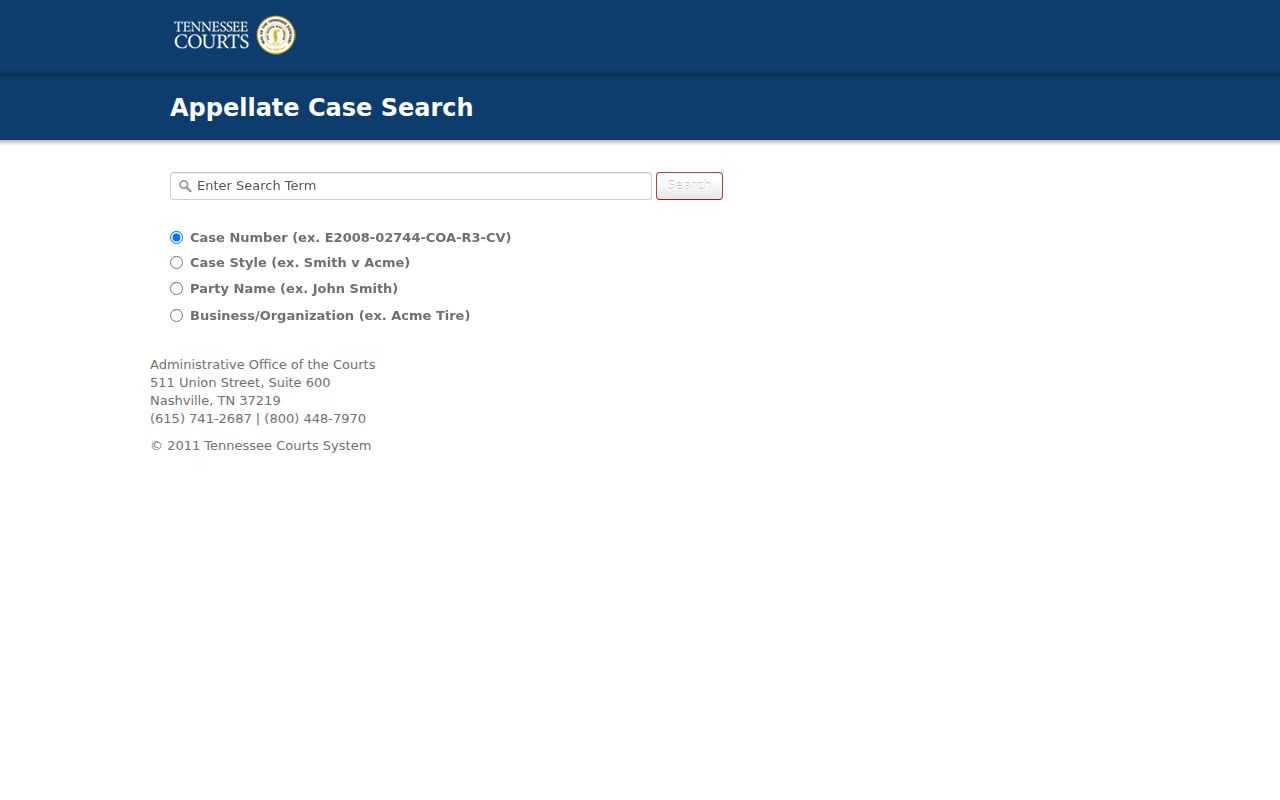
The sparse search form reflects its appellate role: a case number or party name is the useful starting point.
| Field label | Type | Required | Format notes |
|---|---|---|---|
| Case Number | Text | Unspecified | Search by appellate sequence; the numeric sequence may work within a full appeal number. |
| Party Name | Text | Unspecified | Accepts a name fragment, first or last name, case style, or organization. |
| Search | Button | Not applicable | Runs the selected query. |
A result may show the appellate number, style, originating court and county, status, event date and description, an associated party, and a public PDF. None of those fields replaces the local trial file.
Pickett Case Archives After 1934
Old-case research in Pickett County has an unusual hard limit. The original courthouse burned in 1934 and county records were destroyed. The replacement courthouse was completed in 1935 with fire resistance in mind. A missing pre-fire file may therefore reflect permanent archival loss, not a failed name search or a sealed modern case.
The official Public Case History coverage guidance also defines the much later starting dates for online appellate material.
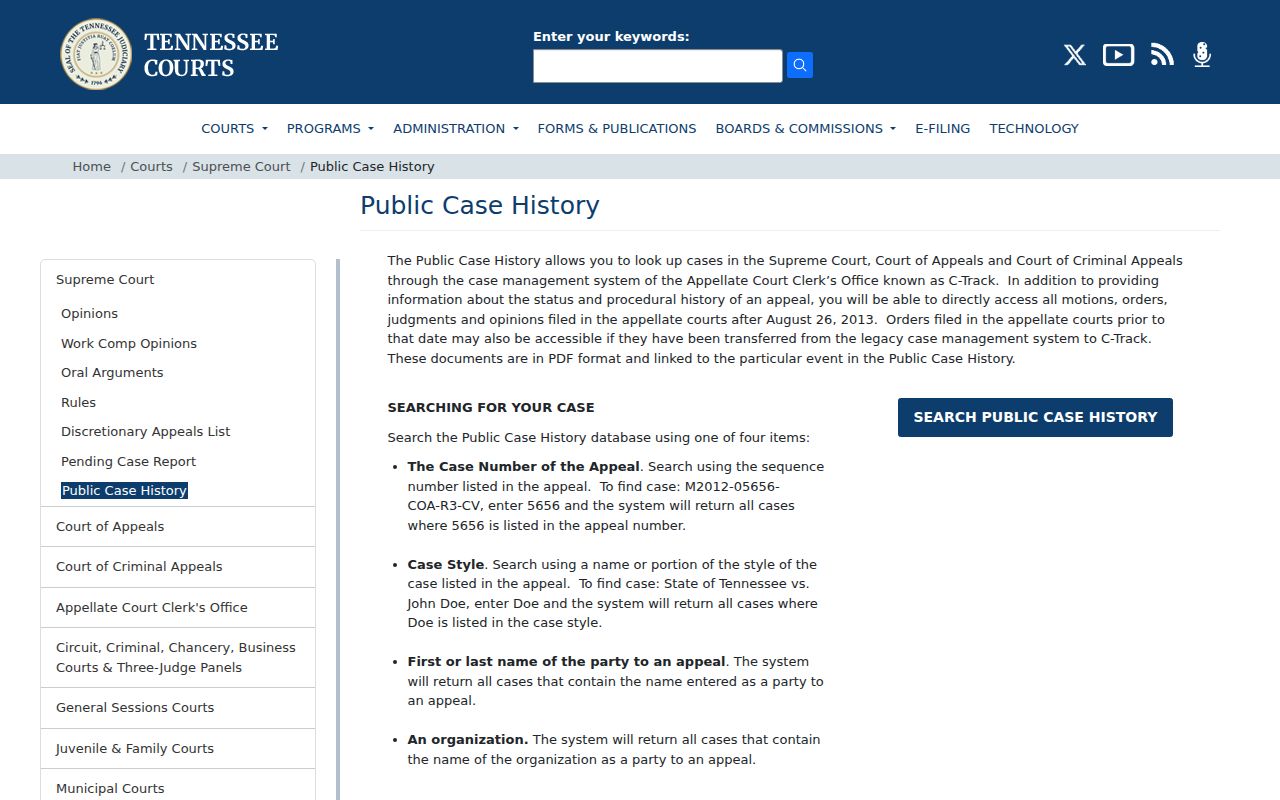
Those online dates do not describe the survival or indexing of Pickett County trial files. For an older matter, give the clerk an approximate year before visiting and ask whether a paper index or surviving file can be retrieved.
Case Record Access & Restrictions
Tennessee Supreme Court Rule 34 permits inspection of court records except material protected by statute, court rule, sealing order, protective order, or another listed ground. Juvenile information, protected victim or minor details, personal identifiers, judicial drafts, and sealed or expunged material may be withheld or redacted. A public docket entry does not guarantee public access to every paper behind it.
The Tennessee Public Records Act provides broad access to public records, while court-file access also follows Rule 34 and the orders entered in the specific case.
When a Pickett County file does not appear, ask the clerk whether the problem is the division, spelling, filing date, archival loss, or a legal restriction. Request the basis for any withheld court material and ask whether a redacted version is available. For an expunged or corrected matter that still appears elsewhere, obtain a certified order from the court and use the receiving agency's correction process.
Copies, certified copies, document format, and retrieval time all require direct confirmation. No official Pickett County fee schedule was found. The safest path is to describe the exact existing record sought, identify the case as closely as possible, and let the originating clerk explain the available form of access.